


• The Starless River Christmas Bookshelf

    Keep your eyes peeled for three weeks of special offers on selected books, starting on the 28th

    Click here for details

  • CNCC Underground Refresher-This Sunday. Space available

    A great chance to polish up your SRT skills with a patient and experienced trainer.

    Click here for details

Drip by drip: Research provides first complete mathematical description of stalagmite shapes

alanw

Well-known member
No mention of helictites, though


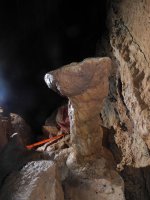
The mathematics reveals one of nature's hidden blueprints: stalagmites grow into flat-topped pedestals, classical columns, or pointed cones not by chance, but according to a single controlling factor—the Damköhler number—which represents a balance between the rates of calcite precipitation and the flow of water.
When dripping is concentrated and steady, a columnar form emerges, while spread-out dripping produces flat tops. When the flow rate is high or when water drips directly onto the stalagmite from the cave roof, conical shapes with sharp pointed tops can emerge.
 
Maybe I'm also a tough audience. What I'd like to know is how the bonsai trees, antlers etc form rather than the simpler stalactites and stalagmites which impressive and beautiful as they can be, don't look baffling and impossible
 
Maybe I'm also a tough audience. What I'd like to know is how the bonsai trees, antlers etc form rather than the simpler stalactites and stalagmites which impressive and beautiful as they can be, don't look baffling and impossible
If nobody has previously described the formation of basic shapes, then that needs to be fully understood before more complex deviations from the established processes can be investigated.
 
Personally, I don't consider myself a tough audience, but sceptic yes.

“spread-out dripping” What does that even mean.

The shape of a stalagmite is clearly dependant on a lot of influences and not just the rate of water flow at a particular spot within a cave system.
A nice attention-grabbing headline, but I don’t believe that stalagmite shape can be defined by a number.
 
Weirdly I can't get to the original paper, the doi in that press release article is incorrect.

Personally, I don't consider myself a tough audience, but sceptic yes.

“spread-out dripping” What does that even mean.

The shape of a stalagmite is clearly dependant on a lot of influences and not just the rate of water flow at a particular spot within a cave system.
A nice attention-grabbing headline, but I don’t believe that stalagmite shape can be defined by a number.
The article is suggesting your intuitive feelings are wrong, and that flow is the predominant effect. What mathematicians call a single number is usual a combination of a several parameters though.
 
I can't either. As you say, the DOI isn't working, and I've searched the PNAS website several different ways without finding it.
A lot of stuff across the pond isn't working as per normal at present, it should all come back to life when the government starts up again, unless of course they fail to re-employ some.
 
That brief explanation makes sense to me although I wonder how far the water droplet has to fall is contributory.
 
Presumably therefore a change in drip volume and rate over a long period leads to formations like this.
 

Attachments

  • DSCN6832.JPG
    DSCN6832.JPG
    149.3 KB · Views: 111
According to Albert Mitchell in Under Ingleborough (written pre WW2, but not published until afterwards), Boyd Dawkins worked that out in the late 1800s:
"Then, some of the formations in Ingleborough Cave were found to be increasing in girth at the rate of one-tenth of an inch in a year, but subsequent measurements indicate only that the rate of growth is dependent (1) upon the rate of flow of water; (2) the amount of lime in solution in the water; and (3) the rate of evaporation in the cave to evaporate the water and harden the deposited lime."

Mitchell referred to helictites as anemolites (formed by wind)
 
Personally, I don't consider myself a tough audience, but sceptic yes.

“spread-out dripping” What does that even mean.

The shape of a stalagmite is clearly dependant on a lot of influences and not just the rate of water flow at a particular spot within a cave system.
A nice attention-grabbing headline, but I don’t believe that stalagmite shape can be defined by a number.
From the paper "Several limitations of this study need to be acknowledged. Our analytic solutions describe stalagmites that grow under perfectly steady, axisymmetric, laminar flow, yet several cave-specific factors fall outside this idealization."

So yes in near-ideal situations it's just the water flow rate (and consequent wetting area) which leads to 3 different shapes, and they had examples where this mathematical model matched real stal very well. However, although they didn't provide examples where their model failed it's clear that in low flow conditions with uneven surface wetting then other shapes may arise.

The paper was only looking at stalagmites - not stalactites or other wall features, which use different mechanisms. I liked it as a paper. (If anyone can't access it, I have institutional rights and could make a copy available).
 
According to Albert Mitchell in Under Ingleborough (written pre WW2, but not published until afterwards), Boyd Dawkins worked that out in the late 1800s:
"Then, some of the formations in Ingleborough Cave were found to be increasing in girth at the rate of one-tenth of an inch in a year, but subsequent measurements indicate only that the rate of growth is dependent (1) upon the rate of flow of water; (2) the amount of lime in solution in the water; and (3) the rate of evaporation in the cave to evaporate the water and harden the deposited lime."

Mitchell referred to helictites as anemolites (formed by wind)
When Whitsun series was first explored there were many Helictites on the roof of Anagram Passage .They all had a right angle addition and they all pointed in the same direction along the passage We concluded at the time that the air currant must have caused this .
 
Back
Top