• Descent 310 is out now.

    ....so prepare to see some of the best writing and photography from the caving world

    Including: Into the Echo Chamber, Tim Allen reports on another magnificent Yorkshire Dales find by the Space Miners....and: The Great Geoff Yeadon, undoubtedly one of the greats of the caving world. Following his death at the age of 75, Geoff Crossley, Martin Grass and Mick Nunwick pay tribute to him.

    Click here for details of this edition

Welsh linguistics - split topic

Rhys

Moderator
Glenn said:
f = hard V
ff = soft V

Not sure about that.

I always say that the Welsh "ff" and "f" are pronounced exactly the same as they are in the English words "off" and "of."

 
It's easy enough to remember the Welsh letter "f" being the English letter "v" by reference to the Welsh word afon (river) and the several English rivers Avon.
 
Peter Burgess said:
It's easy enough to remember the Welsh letter "f" being the English letter "v" by reference to the Welsh word afon (river) and the several English rivers Avon.

Avon is I believe Old English for river, that's why there are so many of them.  :smartass:
 
Les W said:
Avon is I believe Old English for river, that's why there are so many of them.  :smartass:

I believe you are wrong.

http://en.wikipedia.org/wiki/River_Avon (okay, perhaps not the best source, but it's a start)

"River Avon (Old Brythonic abona, "river") is the name of many rivers:"

Brythonic is the language that developed into Welsh, Cornish and Breton, by the way.

 
OK I will rephrase the statement:

Avon is I believe derived from Abona which was Old Brythonic for river, that's why there are so many of them.  :-[

The principle point is that the word Avon came from a previous dialect used in Britain and the word meant River which was why there are so many rivers called Avon.  :tease:
 
Not according to Wikipedia!

"The word Axe is a version of the Celtic word for water.[1]"

Reference 1 that is cited as providing that fact is: "Witcombe, Richard (2009). Who was Aveline anyway?: Mendip's Cave Names Explained (2nd ed.). Priddy: Wessex Cave Club. p. 202. ISBN 978-0950043364. "

http://en.wikipedia.org/wiki/River_Axe_(Bristol_Channel)

I understood Axe, Exe, Usk, whisky and others to be from the same lingusitic root.

Rhys

 
Don't forget that Wikipedia is editable by anyone.

Including people that might not neccessarily know what they are talking about.
 
droid said:
Don't forget that Wikipedia is editable by anyone.

Including people that might not neccessarily know what they are talking about.

However it has been proved to be more accurate than the Encyclop?dia Britannica.
The advantage of Wikipedia is that it is a collaboration. If anything is wrong then somebody *WILL* put it right. The changes are all logged and reviewed, the discussion pages list what has occurred.
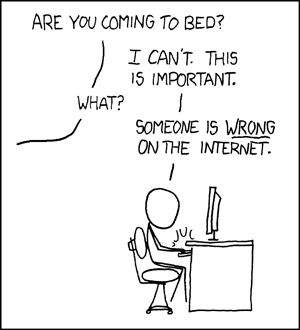
I generally trust Wikipedia to be pretty accurate, there are pleanty of geeks out there who won't allow anything to be wrong on the internet...

duty_calls.png


Image credit: http://xkcd.com/386/
 
Why aren't there Welsh words for Television and Motor Vehicle?  Perhaps Graham, with his extensive knowledge of history and archaeology, could explain why?  ;D
 
exsumper said:
Why aren't there Welsh words for Television and Motor Vehicle? 

Who says? Is that one of those "everyone knows" statements that gets you loads of minus points on QI?

Cerbyd Modur = Motor Vehicle
Teledu = Television
 
The Welsh have a special committee for making up new words as required.

They are worse than the French or Germans who will at least use English (or words stolen by English) words occasionaly


:lol:In a similar vein to my  favourite disparaging French  Joke.

"Q. Why are the roads in France lined with lime tree's, A. So the German Army  can march in the Shade"

The old one's are the best.

My mistake Jessop Smythe, I should have added the word "Authentic" before Welsh words.
 
exsumper said:
My mistake Jessop Smythe, I should have added the word "Authentic" before Welsh words.

Sorry, can you define authentic? If you mean words not derived from another language you're on to a loser.

English is derived from a whole mash of languagues. It's essentially a Germanic tongue to start with with later additions from Latin, Greek, various Indian languages and many others, including the Brythonic dialects (Welsh, Gaelic etc). The list is almost endless, especially as it keeps growing.
As far as I know, the only pure living language is Icelandic. All other languages are quite happy to borrow words from others so you could say that Welsh has actually gone full circle and is now borrowing some back.
 
exsumper said:
My mistake Jessop Smythe, I should have added the word "Authentic" before Welsh words.

Authentic how? The English word television was invented at some stage. I believe it is a mixture of Greek and Latin.

Modern Welsh has adopted plenty of English words directly. Often the spelling has to be mangled to fit with proper Welsh spelling/pronunciation conventions though eg: Ambulance -> Ambiwlans

Rhys
 
Back
Top
