




The Old Ruminator
Well-known member
I found this completely hollow rock in a ploughed field on the Blackdown Hills ( The geology of the Blackdown Hills together with the adjoining East Devon AONB is unique in south-west England, forming part of the only extensive outcrop of Upper Greensand in the region.
The Blackdown Hills form a flat plateau dominated by hard chert bands, made up of clay with flints, of Upper Greensand with some remnants of chalk. The cretaceous rocks rest over eroded Jurassic and Triassic beds, with an outcrop of Rhaetian beds. In the western areas the Upper Greensand is devoid of calcareous material but the sands yield fossils of marine bivalves and gastropods (snails) preserved in silica. )
I assumed it was from an early iron working as it is very heavy. We ran a sophisticated metal detector over it but it is completey non metallic. Now I can only assume its chert but would that be hollow ?
Not actually cave science I know but hoping Andy F. will pick up on it.
 P7250003 by Nicholas Chipchase, on Flickr
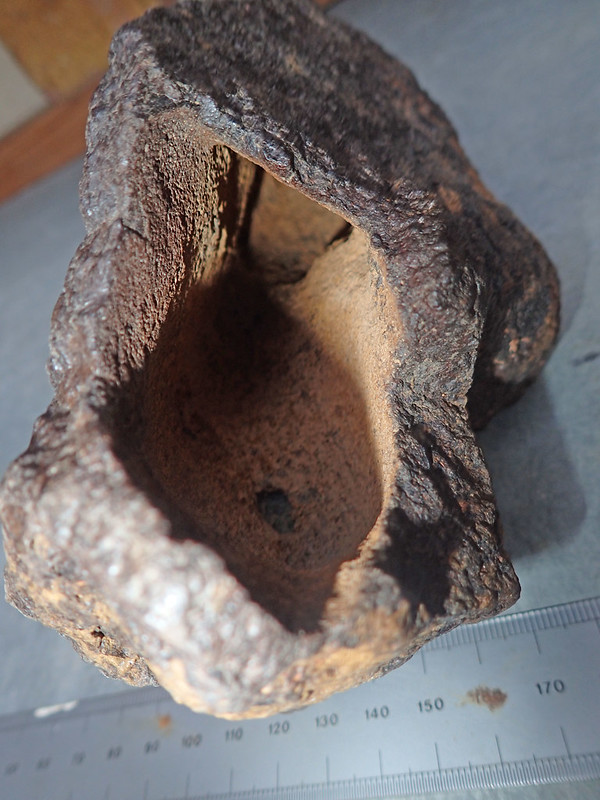 P7250004 by Nicholas Chipchase, on Flickr
The Blackdown Hills form a flat plateau dominated by hard chert bands, made up of clay with flints, of Upper Greensand with some remnants of chalk. The cretaceous rocks rest over eroded Jurassic and Triassic beds, with an outcrop of Rhaetian beds. In the western areas the Upper Greensand is devoid of calcareous material but the sands yield fossils of marine bivalves and gastropods (snails) preserved in silica. )
I assumed it was from an early iron working as it is very heavy. We ran a sophisticated metal detector over it but it is completey non metallic. Now I can only assume its chert but would that be hollow ?
Not actually cave science I know but hoping Andy F. will pick up on it.
P7250003 by Nicholas Chipchase, on FlickrP7250004 by Nicholas Chipchase, on Flickr


